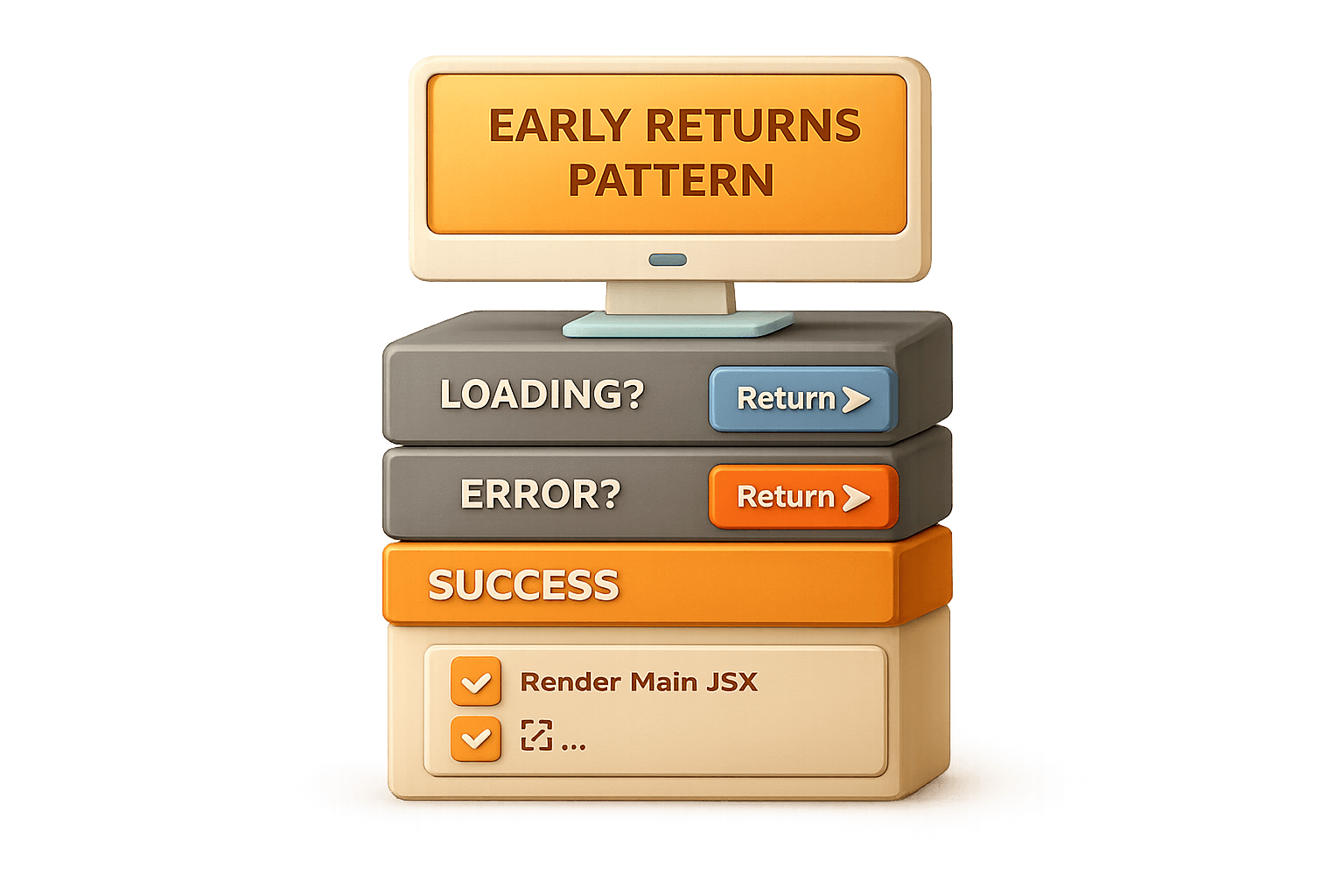
What is the early return pattern?
* If a condition is not met, return immediately *
The idea is straightforward: instead of nesting logic deeply with multiple if/else blocks, you immediately return from a function or component when a condition is not met.
In UI code this usually means:
• Returning early while data is loading
• Returning early when there is an error
• Returning early when required props or state are missing
This keeps the main “happy path” of your component at the bottom, flat and readable.
A basic example:
function UserProfile({ user }: { user: User | null }) {
  if (!user) {
    return <div>No user found</div>;
  }

  return <div>{user.name}</div>;
}
Without an early return:
function UserProfile({ user }: { user: User | null }) {
  return user ? <div>{user.name}</div> : <div>No user found</div>;
}
The second version is already denser, and this gets much worse when you add loading, errors, and permission checks. It leads to deeply nested code that is difficult to follow and maintain.
Why early returns shine in React
Most React components deal with multiple UI states: loading, error, empty, success, and more. Early returns help flatten this structure and improve readability.
A realistic early-return example with multiple states:
type Props = {
  isLoading: boolean;
  error: string | null;
  items: Item[] | null;
};

export function ItemsList({ isLoading, error, items }: Props) {
  if (isLoading) {
    return <p>Loading…</p>;
  }

  if (error) {
    return <p className="error">Error: {error}</p>;
  }

  if (!items || items.length === 0) {
    return <p>No items yet</p>;
  }

  return (
    <ul>
      {items.map((item) => (
        <li key={item.id}>{item.title}</li>
      ))}
    </ul>
  );
}
Now let's see the same logic written with nested ternary operators:
export function ItemsList({ isLoading, error, items }: Props) {
  return isLoading ? (
    <p>Loading…</p>
  ) : error ? (
    <p className="error">Error: {error}</p>
  ) : items?.length ? (
    <ul>
      {items.map((item) => (
        <li key={item.id}>{item.title}</li>
      ))}
    </ul>
  ) : (
    <p>No items yet</p>
  );
}
That's difficult to scan, right?
Early returns make code easy to extend
One of the biggest advantages is how easy it is to add a new rule. If you later need a permission check, you can add one condition without restructuring the rest of the component.
Here is that additional access rule:
type Props = {
  isLoading: boolean;
  error: string | null;
  items: Item[] | null;
  hasAccess: boolean;
};

export function ItemsList({ isLoading, error, items, hasAccess }: Props) {
  if (!hasAccess) {
    return <p>You do not have access.</p>;
  }

  if (isLoading) {
    return <p>Loading…</p>;
  }

  if (error) {
    return <p className="error">Error: {error}</p>;
  }

  if (!items || items.length === 0) {
    return <p>No items yet</p>;
  }

  return (
    <ul>
      {items.map((item) => (
        <li key={item.id}>{item.title}</li>
      ))}
    </ul>
  );
}
Now let's check the if/else mess
The version below works, but it is exhausting to read and maintain. Notice how each new condition pushes the successful path another level deeper:
export function ItemsList({ isLoading, error, items, hasAccess }: Props) {
  if (hasAccess) {
    if (!isLoading) {
      if (!error) {
        if (items && items.length > 0) {
          return (
            <ul>
              {items.map((item) => (
                <li key={item.id}>{item.title}</li>
              ))}
            </ul>
          );
        } else {
          return <p>No items yet</p>;
        }
      } else {
        return <p className="error">Error: {error}</p>;
      }
    } else {
      return <p>Loading…</p>;
    }
  } else {
    return <p>You do not have access.</p>;
  }
}
Final Thoughts
Early returns aren't about style—they're about clarity. They make React components easier to read, test, and extend. That's why this pattern resonates with experienced frontend developers and quietly becomes a default once you adopt it.